The most accessible version of his training levels conception appears in this power training levels article. You can read about it in more detail in the book, Training and Racing With a Power Meter as well as frequently in the Wattage training forum.
Can his training levels, which are based on power (watts) on a bicycle, be adapted to the Concept II rowing machines, which also can display power? I believe this may be possible and I have created a training level calculator to help.
Some key points in the Coggan approach
- the power that you use in an all-out hour effort is a logical choice for deriving other training levels because it "integrates VO2max, the percentage of VO2max that can be sustained for a given duration, and ... efficiency"
- Physiological responses to training "fall on a continuum", so that the adaptations that occur from one intensity blur with those of another intensity. This shows up particularly in the chart of physiological benefits accrued from different intensity exercise.
The upside
- Physiological benefits elicited at different training intensities are displayed in easy-to-read chart. Coggan is quick to point out that these are descriptive levels not prescriptive.
- Sample workouts give you an idea of intensity, duration, and frequency.
- Supported by research. This is evidence-based training advice and while research isn't cited on the web page, it is abundant in the power training forum and in the book.
- Designed for cyclists. Descriptions like "easy spinning" or "just above TT effort" may not easily translate into rowing intensity. However, Coggan provides a perceived exertion rating (Borg Scale), as well as a heart rate reference (see below), so you can transmogrify from that.
- Figuring out your training zones is optimally based on an hour effort. Imagine doing an all-out hour-long piece on the rowing ergometer! We have a hard enough time doing a 20-minute test! Cyclists must be more patient, tolerant (or stupid) than rowers.
- Heart rate zones are provided as a percentage of HR at threshold power (your heart rate at a pace you could maintain for an hour). Coggan is not a big fan of heart rate as a training tool, because it is susceptible to many other variables (heat, emotional state, caffeine and other drugs, etc).
- Training level power numbers are provided as a percentage of hour power. In other words, you need to know your "hour power" to optimally calculate your training levels. It turns out that many people have figured out how to derive their levels with 20-minute all out efforts. More on this later.
- Power (as in watts) is the main focus. For rowers used to 500m splits, this may require some adaptation, but power is available at the click of a button on the ergometer.
Power on the bicycle is typically calculated by measuring torque with strain gauges in one of several places and combining that with angular velocity. If your eyes are about to glaze over with this terminology, don't despair: the bottom line is that if you are doing something to the pedals, a watt-meter on a bike will likely measure it.
By comparison, the rowing ergometer measures power by what happens at the flywheel (source), which is to say, it measures what happens on and as a result of the drive. You pull the handle, which pulls the chain, which pulls the flywheel and that is the power that is measured. It does not measure the amount of work done - however small - on the recovery. Thus, watts on the rowing machine may understate power. Just how many watts are missed depends on various factors, including rower's mass, distance moved by the rower's center of gravity, and most importantly, stroke rate. Carl Douglas, boat designer and inveterate tinkerer of things physical, spent some time calculating how many watts might be missed and you can read that discussion here. If you accept his assumptions and calculations, a rower might lose anywhere from 5 to 27 watts with stroke rates between 20 and 30. However, at a stroke rate of 40, you might lose up to 100 watts.
The power you can maintain in all-out effort (time-trial or "test") for 60-minutes is deemed to be a good measurement by many exercise physiologists of lactate threshold (LT) power. In Threshold power: what is it, why is it important, and how do I measure it? Coggan suggests that an all-out 1 hour effort is the best way to ascertain "threshold power." According to Coggan. "Power at lactate threshold (LT) is the most important physiological determinant of endurance cycling performance..." He adds more decisively:
LT - especially when expressed as a power output...is the single most important physiological determinant of performance in events ranging from as short as a 3 km pursuit to as long as a 3 week stage race. Just as importantly...this parameter provides a physiologically sound basis around which to design any power meter-based training program.In a bit of rowing corroboration, Stephen Seiler, rower and exercise physiologist, emailed me to say that a 60-minute effort on the rowing machine is the best way to ascertain lactate threshold intensity for rowers.
Of course, you can also have your lactate threshold and power at lactate threshold measured at labs such as this one at UCDavis, but they may involve a bit of blood letting. The hour-power test may seem more appealing.
Can you derive "hour power" from some shorter test?
An amazing amount of time and energy has gone into figuring out a shorter alternative to the 60-minute all-out test, particularly on the wattage cycling forum. Authors like Joe Friel and Eddie Monier favor a critical power duration curve, such that you test some representative times and derive others. So, for example, if you know your "critical" power at 6 minutes and 12 minutes, you can likely figure out a reasonable approximation of your 60-minute power. Below is an example of such a curve.
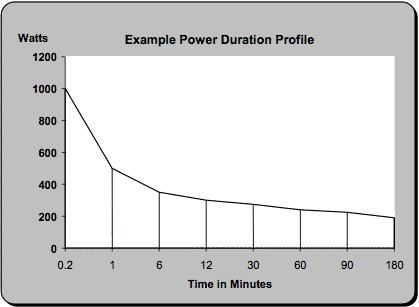
Source: Eddie Monnier Critical Power
Following this approach, many cyclists (as expressed in the wattage forum) have found that 60-minute power is somewhere between 93% and 97% of 20-minute average power. Many just settle for 95%, acknowledging that an exact number may not be that important (and many are using software that will help them hone in on better numbers).
Here is an example of how you might figure out your threshold power using a 20-minute piece. If your average power in watts for 20-minutes is 200, then your average power for 60 minutes might be 5% less or 190 watts.
Does this system work for rowers?
The answer is not so clear. I created an Excel spreadsheet a few years ago to try this out. More recently, I created a javascript level calculator. You can enter your 20-minute average 500m split and the calculator derives your training levels based on 94% of the power associated with this split. My own experience is that the lower intensity levels seem to represent something fairly reasonable, but when you get to level 5 and 6, the prescribed pace range actually lags what I would expect. In other words, I would expect to have to go harder. And, given Carl Douglas' point about the ergometer understating watts, particularly at higher rates, one would expect the intensities to be too hard relative to the cycling-derived power levels. However, that does not seem to be the case.
How does the Coggan arrangement stack up against, say, Royle's?
Coggan's descriptive levels and Royle's prescriptive categories are different in a few regards, but similar as well. The most obvious difference is that Royle's categories go in the opposite direction (intensity increases as the category number decreases) from Coggan's levels (intensity increases as the number level increases).
A fundamental difference between the Coggan and Royle approaches is the expected physiological adaptations. For instance, in Royle's schema, "Cat III rowing increases VOmax." (from November 2002 Technical Tip). You get the sense that if you want to develop VO2Max, Cat III is the only category to do this. In fact, the categories seem to be non-overlapping and highly specific. Coggan, on the other hand, shows in his Expected physiological/performance adaptations (Table 2), that you get VO2max benefits from levels 2, 3, 4, 5, and 6, with the most coming from level 5.
Royle suggests you develop increased capillarization and greater numbers of mitochondria at the lower intensities (Cat V and VI). This is accompanied with admonition that "Going too fast at the lower rates denies your body the opportunity to develop optimum capillary and mitochondria density" (source), while Coggan suggests level 4 (threshold) and level 5 (VO2Max intensity) as the training intensities most associated with these adaptations (source). In other words they seem to be at opposite ends of the intensity spectrum on this apparently important issue. This basic disagreement deserves further examination in another post.
My adaptation of Coggan's levels as shown in the levels calculator and the training category calculator ala Marlene Royle are both based on a 20-minute piece, so it is easy to compare Royle's prescribed training category pace with the levels as derived from Coggan. CAVEAT: I think it's important to note that the levels calculator is experimental and based on a somewhat arbitrary calculation (94% of watts of a 20-minute piece to signify threshold power). I do not claim this represents Coggan's thinking or his approach. In fact, he might well tell you that you should row for an hour. Since I know few rowers who will do this, we'll just go with the experiment and try to disassociate this effort with Coggan himself, while giving him credit for many of the underlying ideas. Finally, he would label these levels as descriptive rather than prescriptive. So, when I say "ala Coggan" this is what I mean.
Phew! With that caveat aside, I looked first at the respective level or category targeting VO2max improvement: Royle's Cat III and Coggan's level five. I compared a 20-minute 500m split of 1:51.0 in both schemas. Royle's system suggests a Cat III split of 1:49, while Coggan's level five--as represented in the levels calculator--suggests a range from 1:46.6 - 1:51.1. In effect, the results are very similar. The example workouts aren't particularly different either. Both seem to like 5 x 5-minutes and related.
For lactate threshold development, Royle calls for Cat IV and Coggan calls for level four. Royle's system suggests a workout pace of 1:53, while the level calculator suggests a range between 1:51.5 - 1:56.9. Again, that seems remarkably similar - Royle's number is smack dab in the middle of the level calculator's range. However, when you compare workouts, it is a different matter. Royle's suggested workout of 3 x 20 minute intervals is way, way too hard - essentially impossible - for myself and others I know. Several people who have been employing Royle as a coach have corroborated this. She also lists 4 x 10 and 1 x 30-minute workouts (see "Workouts: Category IV Anaerobic Threshold Training") . Coggan's recommended threshold workouts include intervals or repeats in the 10-30-minute duration, with a common workout being 2 x 20-minutes. These workouts, with a 5.5 second 500m split range, seem considerably more plausible.
In conclusion, the Coggan training levels deserve further consideration, particularly for those training on a rowing ergometer. This training schema affords a rational, science-based arrangement that, while designed for cycling, may have applications in rowing.


